Brand Yourself Bold: Online Branding That Converts

Brand Yourself Bold: A Practical Playbook for Building an Online Brand That Converts
A strong online brand makes it easier to earn trust, charge confidently, and attract the right clients without constant reinvention. “Bold” branding isn’t a bigger personality or louder posts—it’s a clear, repeatable system that helps people instantly understand what you do, who it’s for, and why it’s different. Below is a practical playbook you can run any time you want to tighten your positioning, sharpen your message, and build a brand that feels consistent everywhere customers interact with you.
What “bold” branding looks like online
Bold branding is recognizable before someone even reads every word. It’s the combination of clarity, consistency, and intentional decisions that stack up across every touchpoint.
- Clarity over complexity: a simple promise, a specific audience, and a recognizable point of view.
- Consistency across touchpoints: profile bios, posts, offers, emails, and landing pages reinforce the same story.
- Confidence without noise: bold doesn’t mean loud; it means unmistakable.
- A brand is a system: positioning + message + visuals + content rhythms + offers that match the promise.
Branding is also tied to credibility. People decide quickly whether they trust what they’re seeing, and consistency is one of the fastest ways to reduce doubt. Research and UX guidance on credibility highlights how visual design, clarity, and perceived expertise shape trust signals online (Nielsen Norman Group: Trust and Credibility).
Start with positioning that makes decisions easier
Positioning is your brand’s “yes/no filter.” It determines what you talk about, what you don’t, how you structure offers, and which customers feel like you’re speaking directly to them.
- Define the audience by situation: focus on what’s happening right now (stuck, scaling, rebranding, launching), not only demographics.
- Choose a sharp outcome: name the tangible result customers want after buying.
- Set boundaries: who it’s not for, what approaches you avoid, and what values guide decisions.
- Create a one-line positioning statement: “Helping [audience] achieve [outcome] using [method/point of view].”
- Pressure test it: if two competitors can copy/paste it, add specificity (niche, constraints, timeframe, or a distinct method).
Positioning quick-check table
| Element | Good | Better | Best |
|---|---|---|---|
| Audience | Everyone who needs help | A broad group with one shared need | A specific group in a specific moment |
| Outcome | Grow online | Get more leads | Convert warm audiences into booked calls consistently |
| Method | Branding tips | Step-by-step process | A repeatable system with templates and weekly actions |
| Proof | Claims | Some examples | Clear outcomes, case studies, or measurable before/after |
| Tone | Generic | Friendly | Distinct voice that matches the promise |
Craft a message people remember (and repeat)
Once positioning is set, messaging turns your strategy into language people can quickly repeat to someone else. If customers can’t explain what you do in one sentence, they usually won’t buy yet.
- Build a message hierarchy: (1) core promise, (2) three pillars, (3) supporting proof points, (4) signature phrases.
- Translate features into meaning: don’t stop at “what’s included”—state what changes for the customer.
- Use before/after language: name the current frustration and the desired future in concrete terms.
- Create a short origin story: the insight moment, the shift, and the commitment to your audience.
- Align message with the offer: bios, landing pages, and emails should echo the same promise.
A practical benchmark: your core promise should be easy to spot within five seconds on your profile and within the first scroll on your offer page. That’s where many conversions are won or lost.
Design brand assets that look cohesive on every platform
Visual identity is less about decoration and more about recognition. Cohesive design reduces “Is this legit?” friction and supports your perceived value. The American Marketing Association describes branding as the set of features that identify and differentiate an offering (AMA Dictionary: Branding), and design is a major part of those recognizable features.
Create a content system that builds trust before the sale
Simple weekly content rhythm
| Day/Slot | Goal | Example topic |
|---|---|---|
| 1x Long-form | Authority | A step-by-step framework for clearer positioning |
| 2x Short-form | Affinity + clarity | Common mistakes, myths, behind-the-scenes decisions |
| 1x Proof | Trust | Before/after story or a mini case study |
| 1x Offer invite | Action | Direct link to the guide, free resource, or booking page |
| Ongoing | Engagement | Answer questions, DMs, comments, and polls tied to your pillars |
Turn the brand into revenue with aligned offers
A practical next step: a guided branding roadmap
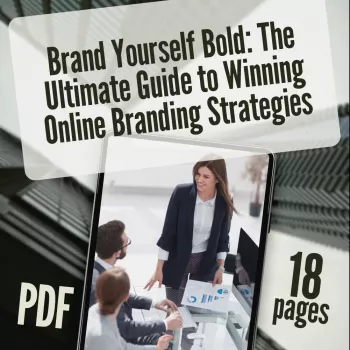
- For a guided, repeatable system, explore Brand Yourself Bold: The Ultimate Guide to Winning Online Branding Strategies (Digital Download PDF).
- To support follow-through and planning, pair it with Purposeful Progress: How to Set Goals with Kaizen & Ikigai (Goal Setting eBook) so your brand work turns into weekly actions.
FAQ
What’s the difference between a personal brand and a business brand?
A personal brand is anchored to an individual’s voice, story, and reputation, while a business brand can stand on its own without the founder being the main “face.” Both still need clear positioning, consistent messaging, cohesive visuals, and a reliable customer experience.
How long does it take to see results from online branding?
Clarity and consistency can improve within a few weeks, especially once your bio, offer page, and content themes align. Stronger trust and steadier conversions usually compound over a few months, depending on your posting cadence, offer-market fit, and how you distribute content.
Is a digital download PDF useful if branding changes over time?
Yes—foundational positioning and messaging frameworks tend to stay stable even as visuals and offers evolve. A PDF guide is useful for periodic refreshes because you can revisit the same exercises and checklists whenever you refine your niche, update your offer, or relaunch.











Leave a comment